Sunrises and sunsets on the French Riviera – where and when to watch them
The French Riviera is known for its blue sea at midday, but it is often at its most beautiful at the start and end of the day. In the morning the sky turns pink above Monaco and Cap Ferrat; in the evening the Baie des Anges in Nice turns golden and the red rocks of the Esterel glow in the last light. To see it, though, it is not enough to climb the first viewpoint you find at the time shown in your weather app. The sun rises and sets at different points on the horizon depending on the season, and the coast is full of hills, capes and bays that can hide it.
This guide explains when and where to look for the sun and how to prepare so you do not miss the best moment.
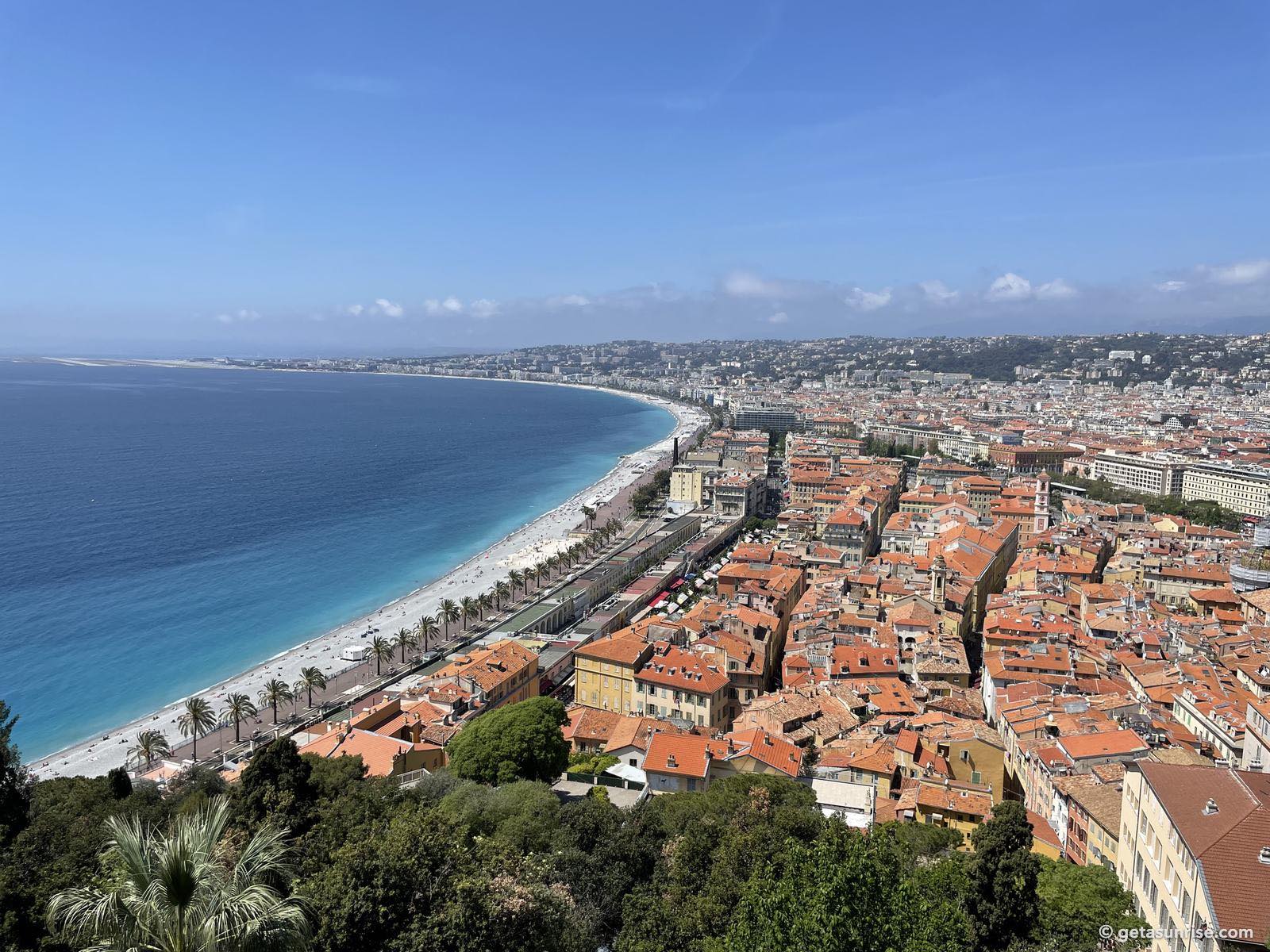
Why it is not that simple on the French Riviera
Most of the coast faces south. From a typical beach you look out to sea, but the sun neither rises nor sets right in front of you – in the morning it appears somewhere on your left, in the evening it disappears on your right. On top of that the coastline is very jagged: Cap d'Antibes, Cap Ferrat, Cap Martin and the Esterel massif reach far into the sea and often stand exactly where the sun goes down.
The second factor is the season. At this latitude the point where the sun rises moves by almost 70 degrees over the year:
- in June the sun rises in the north-east and sets in the north-west – often over land, behind the mountains;
- around the equinoxes (March, September) it rises almost due east and sets almost due west;
- in December it rises in the south-east and sets in the south-west – and from many places you can then see it over the sea.
In practice it is easier to see the sun come out of the sea or set into it in winter, while in summer you need to choose your spot carefully, because the sun often rises and sets over the mountains.
Sunrise and sunset times through the year
In Nice the times change roughly like this:
- the earliest sunrise comes in mid-June, at about 5:50,
- the latest sunset at the end of June, at about 21:15,
- the earliest sunset in early December, at about 16:55,
- the latest sunrise in early January, at about 8:00.
Remember that the official sunrise and sunset times assume a flat horizon. If there is a hill between you and the horizon, the sun will appear later or disappear earlier – sometimes by a few minutes, sometimes by more than ten. From high viewpoints such as Tête de Chien above Monaco, on the other hand, the sun can stay visible a minute or two longer, because you are looking over the curve of the sea.
Golden hour and blue hour
The most beautiful light does not come exactly at sunrise or sunset. Golden hour is the time when the sun is low above the horizon – roughly the hour after sunrise and the hour before sunset. The light is warm and soft and the shadows are long, which brings out the colours of old villages and rocks.
Blue hour begins just after sunset (and ends just before sunrise). The sun is gone, but the sky turns a deep blue and the city lights are on. It is a good time to photograph Monaco, the port of Nice or Villefranche-sur-Mer from above.
If you are going to watch a sunset, arrive at least half an hour early and do not leave as soon as the sun has gone – the most colourful sky often comes a few, or even ten to fifteen, minutes later.
Weather: when the sky will be colourful
A cloudless sky means you will see the sun, but not necessarily spectacular colours. The most beautiful sunrises and sunsets happen when:
- the horizon is clear, so the sun can light the clouds from below,
- there are medium or high clouds higher up – they are the ones that catch the red and pink light,
- the air is clear – in winter and after a weather front visibility can be excellent; on very clear winter mornings you can even see the mountains of Corsica from higher viewpoints.
The worst case is a thick band of low cloud on the horizon – the sun disappears behind it before it can colour anything. In summer a haze over the sea also blurs the horizon and the distant mountains.
Where to watch the sunrise
The best places for sunrises are those with a view of the sea to the east and south-east.
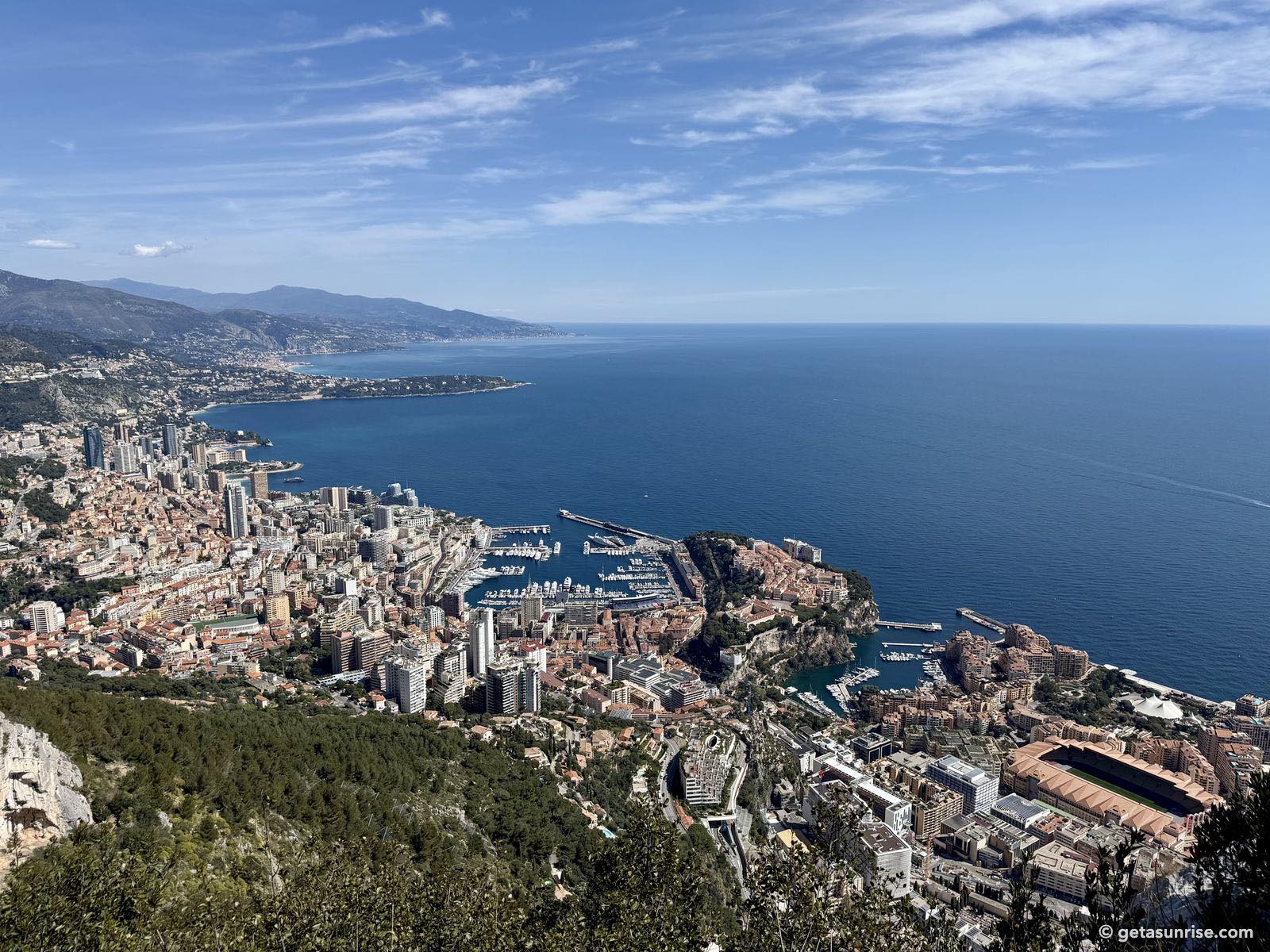
- Tête de Chien above Monaco – a rocky headland high above La Turbie, looking over Monaco, Cap Martin and the Italian coast. From February to November the sun rises inside the frame, in spring and autumn straight out of the sea.
- The bay of Villefranche-sur-Mer – from the Moyenne Corniche road you see the town, the bay full of boats and the Cap Ferrat peninsula. Sunrises from mid-January to late November.
- The old cemetery in Menton – high above Menton, looking over the Garavan harbour and the coast towards the Italian border. The sun rises inside the frame from early March to mid-October.
- The Promenade des Anglais in Nice – winter sunrises over the sea, to the right of the hill of Mont Boron, from late September to mid-March. The easiest sunrise in Nice – just walk down to the promenade.
- La Gravette beach in Antibes – a small beach by the old town, looking over the Baie des Anges and the mountains around Nice.
- Cap Dramont near Agay – the red rocks of the Esterel and the coast towards Anthéor; a view for summer sunrises.
- Pampelonne beach near Saint-Tropez – a boardwalk onto the beach and open sea to the east; for most of the year the sun comes straight out of the water.
- Port Grimaud – a view from the church tower over the canals to the Gulf of Saint-Tropez; summer sunrises from mid-April to late August.
Where to watch the sunset
A sunset over the sea on the French Riviera is easiest to see in autumn and winter, from places facing south-west and west.
- Castle Hill in Nice – the classic view of the Baie des Anges and the Promenade des Anglais. From mid-August to late April the sun sets inside the frame, in winter on the left, over the sea beyond the airport.
- Mont Boron – a terrace higher up and further east than Castle Hill, looking over the port, Castle Hill and the whole Baie des Anges. Sunsets inside the frame from late August to mid-April.
- Tête de Chien towards Nice – winter sunsets over Cap Ferrat and the Baie des Anges, from mid-October to late February.
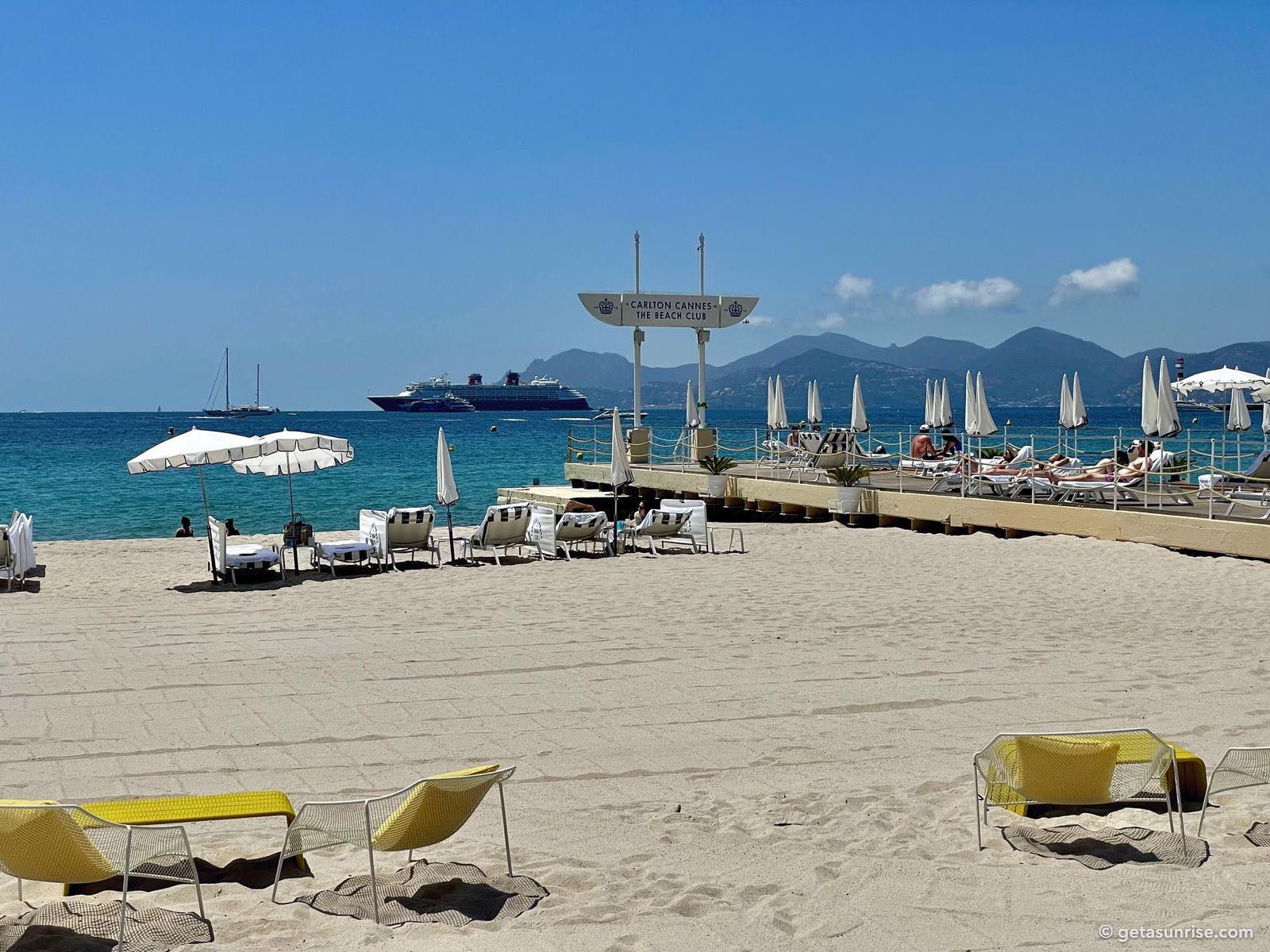
- Carlton beach in Cannes – sunsets behind the Esterel massif, inside the frame from November to February.
In summer the sun sets far to the north-west, often behind the mountains inland. Then it is worth looking for places that face more to the west, or simply enjoying the golden-hour light on the rocks and buildings.
How to prepare
- Check exactly where the sun will be. On getasunrise.com you choose a viewpoint and a date, and on a real photo you see the sun's path and the moment it hides behind a hill or comes out from behind it.
- Look at the forecast. For every view we show the chances of seeing the sun and a colourful sky over the next few days.
- Arrive early. Half an hour before sunrise or sunset is the minimum, especially if you have to walk uphill or find a parking space.
- Bring a torch and something warm. Viewpoints high above the sea can be windy and cool, and it gets dark quickly after sunset.
- Check the opening hours. Some places, such as the park on Castle Hill, close in the evening.
Frequently asked questions
- Can you see the sun set over the sea on the French Riviera?
- Yes, but it is easiest in autumn and winter, when the sun sets in the south-west. In summer it usually sets over land, behind the mountains.
- Where is the best place to watch the sunrise in Nice?
- In winter – the Promenade des Anglais, where the sun comes out of the sea to the right of Mont Boron. For most of the year you can see beautiful sunrises from Villefranche-sur-Mer and from Tête de Chien above Monaco.
- What time does the sun rise and set on the French Riviera?
- In Nice sunrise ranges from about 5:50 in June to about 8:00 in early January, and sunset from about 16:55 in December to about 21:15 at the end of June. You will find the exact times for any date and place with each viewpoint.
- Why does the sun disappear earlier than the forecast says?
- Because the official sunset time assumes a flat horizon. If there are hills towards the west, the sun hides behind them a few minutes, or even more than ten minutes, earlier.